Why Is a Muslim Woman Unfit to Be a Judge in Mississippi?
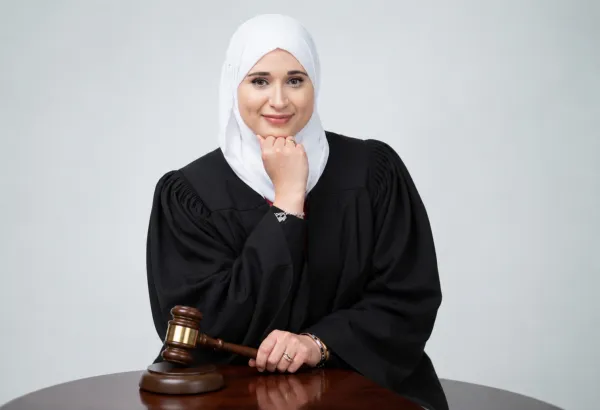
A municipal judge’s appointment in a small Mississippi Delta town has drawn social media backlash, from internet trolls and a few Mississippi politicians called for her removal, because she is Muslim. Photo credit: mississippitoday.org
July 5, 2026, was a historic day for Muslims, especially Muslim women, in the state of Mississippi.
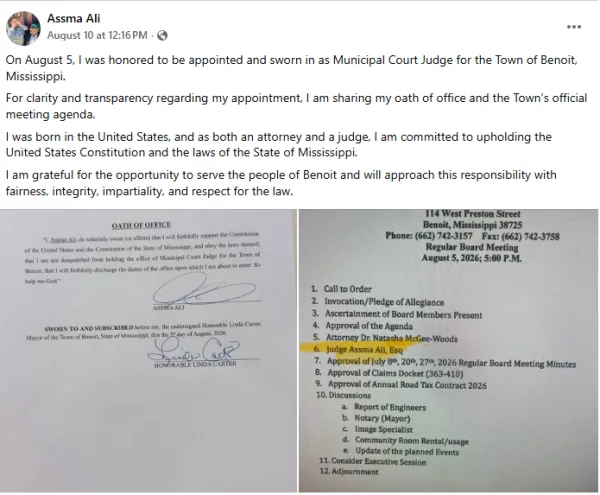
On that day, Assma Ali announced that she had been appointed a municipal court judge in Mississippi. In a statement celebrating the appointment, Ali wrote that she was “honored and humbled” and pledged to continue serving her clients as an immigration attorney while faithfully carrying out her judicial responsibilities.
Ali's appointment is significant not simply because she is a woman or because she wears the hijab, but because her appointment represents another step in the growing presence of Muslim Americans in the American legal system.
Yet instead of celebrating that milestone, some politicians have chosen to question whether a Muslim woman belongs on the bench at all.
That raises a fundamental question: Why should a Muslim woman be considered unfit to serve as a judge simply because she is Muslim?
According to reports cited by Mississippi media, criticism of Ali's appointment has focused on her Muslim faith and her hijab. Ali, an American citizen of Yemeni descent and an immigration attorney with years of legal experience, has rejected any suggestion of wrongdoing and emphasized her commitment to upholding the United States and Mississippi constitutions.
That is where this controversy becomes much bigger than one judge, one town or one political dispute.
It becomes a question about what America means when it promises religious freedom.
The Constitution Is Clear
I believe it would benefit anyone questioning a Muslim's qualifications for public office to read the founding document of the United States.
Article VI of the U.S. Constitution is explicit: “No religious Test shall ever be required as a Qualification to any Office or public Trust under the United States.”
Mississippi's own Constitution is equally clear. Article 3, Section 18 states: “No religious test as a qualification for office shall be required.” It also says that no preference shall be given by law to any religious sect or mode of worship.
In other words, the Constitution does not say that a person must be Christian to serve the public. It does not say that a person must hide her Muslim identity to sit on a bench. And it certainly does not say that wearing a hijab disqualifies a qualified attorney from judicial service.
A judge's qualifications should be measured by her knowledge of the law, integrity, judgment, temperament and commitment to justice—not by the religion she practices.
Jefferson and the Muslim Question
For those who believe Islam somehow falls outside the American tradition, American history tells a different story.
Thomas Jefferson had a lifelong intellectual interest in Islam and owned a copy of the Qur'an, which he purchased in 1765 while studying law. More importantly, Jefferson advocated a broad conception of religious liberty. His Virginia Statute for Religious Freedom helped establish the principle that civil rights should not depend upon religious belief.
Jefferson later described the statute as protecting “the Jew and the Gentile, the Christian and Mahometan, the Hindoo, and infidel of every denomination.” The terminology is dated, but the principle is unmistakable: religious belief should not determine a person's civil rights.
Muslims were also present in America long before the modern Muslim immigration that many Americans associate with Islam. Historians have documented the presence of Muslim Africans among the people brought to North America through slavery.
So the suggestion that Muslims are somehow foreign to the American story is historically inaccurate.
Muslims Serve America Too
Muslim Americans have served this country in its military, worked in its hospitals, taught in its schools, practiced law in its courts and contributed to communities across the nation.
As a retired U.S. Air Force veteran, I know firsthand that service to America is not determined by one's religion.
A Muslim does not become less American because she prays differently. A Muslim attorney does not become less qualified because she wears a hijab. And a Muslim judge does not become less capable of administering justice because she believes in Allah.
Muslims believe in God. In Arabic, the word for God is Allah. Muslims do not worship the Prophet Muhammad, peace be upon him. Muslims believe Muhammad was God's final prophet and messenger.
That distinction should not have to be explained in 2026, especially by public officials.
Judge Ali's Record Matters More Than Her Hijab
Ali's professional record should be the focus of any legitimate discussion about her fitness for the bench.
Her professional biography identifies her as an immigration attorney with experience representing clients in immigration matters and lists numerous professional and community recognitions. It also lists her as a recipient of a 2026 Outstanding Woman Lawyer of the Year honor.
That achievement should have been a moment of pride.
Instead, criticism of her judicial appointment reportedly came at virtually the same time.
What should matter is whether Judge Ali understands the law, treats people fairly and faithfully applies the Constitution. Those are legitimate questions for any judge. Her religion is not.
Meet Your Muslim Neighbors
Mississippi has Muslim communities, families, professionals and veterans who are part of the state's social fabric.
If a public official has questions about Islam, I would encourage that official to visit a mosque, meet Muslim constituents and speak with them face to face.
It is much easier to fear or ridicule people when you do not know them.
Meet your Muslim neighbors. Listen to their stories. Learn about their faith. You may discover that they are not the people some politicians would have you believe they are.
America is supposed to be big enough for all of us.
An Apology Is in Order
Everyone in America is entitled to express an opinion, even an opinion that others find offensive or bigoted. But public officials carry an additional responsibility because their words can influence public attitudes toward entire communities.
When religious identity becomes the reason someone is deemed unfit for public service, we should all be concerned.
The issue is not whether Judge Ali is Muslim.
The issue is whether we are still willing to honor the constitutional promise that a person's religion should not determine whether she can serve her country.
If Judge Ali has violated the law, then present the evidence and hold her accountable like any other judge.
But if the objection is simply that she is Muslim and wears a hijab, then the problem is not with Judge Ali.
The problem is with the prejudice being directed at her.
America's promise of religious liberty belongs to Muslims too. And Mississippi's Constitution says so.
Caption for bottom video: Assma Ali, an American citizen of Yemeni descent and an immigration attorney with nearly a decade of experience, was appointed to the Benoit municipal court in Bolivar County. She has denied any wrongdoing and emphasized her commitment to upholding the U.S. and Mississippi constitutions. Social media.
Mahmoud El-Yousseph is a Palestinian freelance writer and retired U.S. Air Force veteran. He writes about U.S. foreign policy, Middle Eastern affairs and justice.